
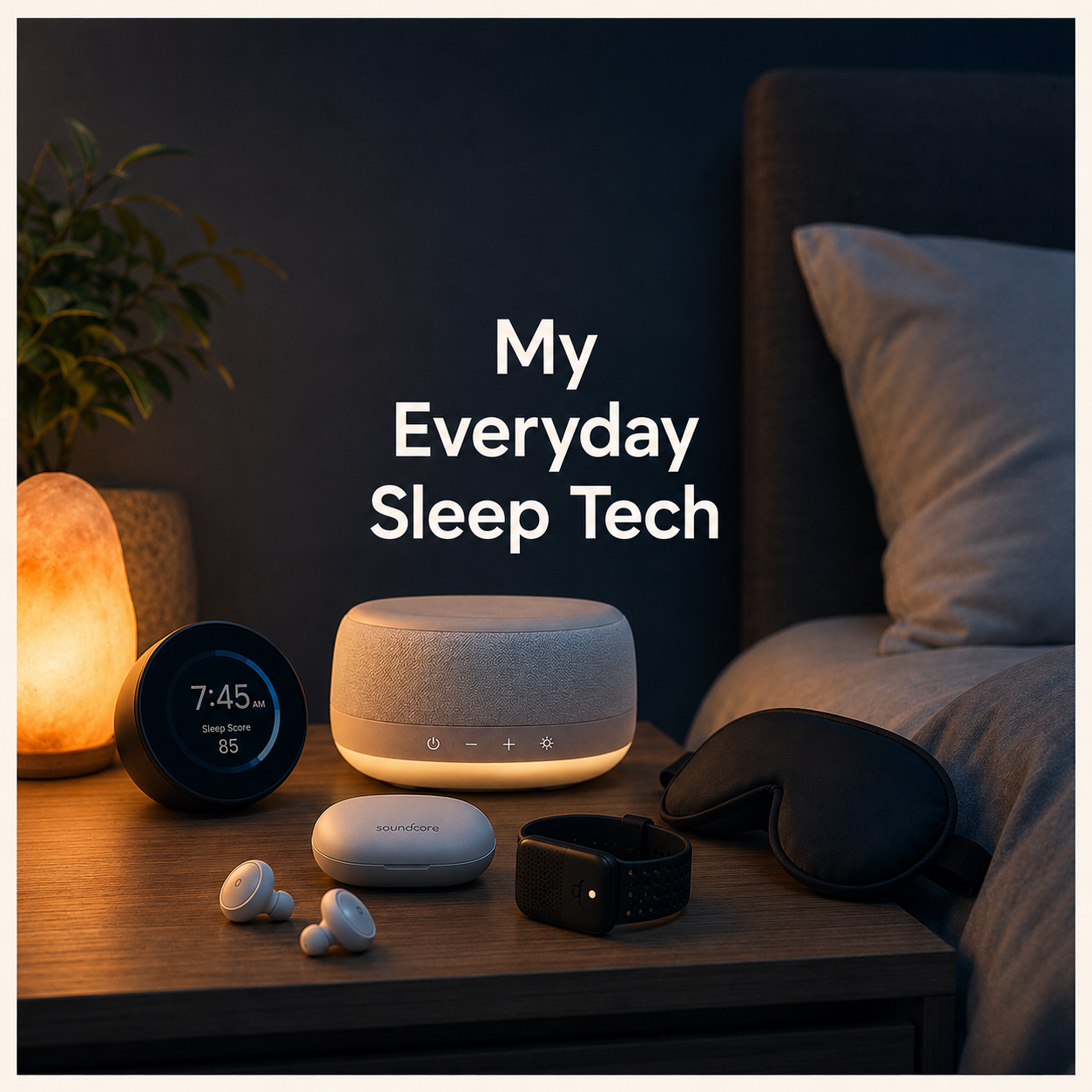
Have you ever wondered what someone who’s spent over ten years focused on sleep actually keeps on their nightstand? This list isn’t just for this post — it’s my real setup: the better sleep solutions I’ve built up over years of figuring out what truly helps me sleep. For the record, I don’t make any money from this site. There are no affiliate links or sponsorships, so everything I mention is here because it works for me, not because anyone paid me to include it.
Just to be clear, I’m not a doctor or a sleep expert. I’m simply someone who’s spent over ten years learning about sleep and trying out what works for me. Everything below comes from my own experience, not medical advice.
A quick heads-up: most of the products I mention are the latest versions as of when I wrote this. Companies update their models often, so before you buy anything, check that you’re getting the newest version rather than one the company has already replaced or discontinued.
Jump to a section:
- The Big Idea: Day and Night Contrast
- Staying Active During the Day
- One Size Doesn’t Fit All
- The Bed Itself
- Temperature Control That Actually Works
- The One Piece I’m Not Fully Sold On
- Light, Darkness, and Circadian Rhythm
- What I Take Before Bed
- Tracking What’s Actually Happening
- The Small Stuff That Adds Up
- Good Sleep Solutions Worth Trying First
- If You’re Still Not Sleeping Well
- Bottom Line: Better Sleep Solutions I Actually Use
The Big Idea: Day and Night Contrast
If I had to pick one idea that’s helped my sleep more than any product, it’s creating a clear difference between day and night. When most people worked on farms, this happened naturally: hard work outside during the day, candlelight at night, and early bedtimes. Modern life doesn’t give us that, so I’ve had to create it myself. The two most important factors are movement and light.
Staying Active During the Day
Right after I wake up, I do some light stretching in bed. Throughout the day, I aim to move for 1 to 3 minutes every hour, wherever I am. The Wakeout app helps me stick to this, so I don’t end up realizing at 4 p.m. that I’ve been sitting for six hours.
If you’re interested in how I handle light for day and night, keep reading. I’ll cover that in its own section below.
One Size Doesn’t Fit All
Before I get to the list, here’s one honest note: what works for me might not work for you. No matter what the research says, trust your own experience and feelings over what a study suggests you should feel.
Temperature is a good example. Research suggests that 65°F to 70°F is ideal for sleep, and that works for me. My wife, who I call the “Queen of Sleep” and whose Oura score was 95 this morning, can’t sleep well if it’s cold. She uses a BedJet to keep her side of the bed warm.
So, keep an open mind as you read the rest of this list. Try things out, and don’t hesitate to return anything that doesn’t work for you.
The Bed Itself
Everything starts with your bed, so that’s where I’ll start too.
The base layer is an Eco Terra Hybrid Latex Mattress. It has a 3-inch organic latex layer over individually encased coils, with an organic cotton and wool cover. There’s no polyurethane or chemical flame retardants, and it carries Oeko-Tex and CertiPUR-US certification. You can choose between two firmness options, depending on how you sleep.
On top of that, I use an Eco Terra Natural Latex Mattress Topper. It uses the same single-origin, certified organic latex, but in a thinner, softer layer. If the mattress alone isn’t quite right, this topper helps adjust the feel.
For sheets, I use The Lad Collective’s Atlantic 3.0 Fitted Sheet, a blend of 60% bamboo and 40% cotton, which helps regulate temperature and resists odor better than regular cotton. It also has labeled corner-loop straps, so you always know which corner goes where and don’t have to struggle with the sheet late at night. I don’t use a top sheet.
I use two blankets, which might sound unnecessary, but there’s a reason. The bottom layer is a Bedsure 100% Cotton Waffle Weave Blanket, and the top is a Whisper Organics Organic Cotton Waffle Weave Blanket, both GOTS and Fairtrade certified. Both are breathable and help regulate temperature — stacking two gives me some weight and lets most of the heat escape while still keeping some warmth if I need it. After trying many other options, including high-end duvets, and even discussing it with ChatGPT, this setup works best for me.
Temperature Control That Actually Works
If I had to pick one thing that’s made the biggest difference, it would be the Chilipad 2.0 from Sleepme. It’s a water-based cooling and heating system with a control unit under the bed, a water-filled pad on the mattress, and a slick bedside remote. It circulates temperature-controlled water through the pad instead of just blowing air. You can set it anywhere from 55°F to 115°F, and the dual-zone version lets you and your partner choose different temperatures for each side. You don’t need a subscription, which is a relief when so many things now want a monthly fee.
The One Piece I’m Not Fully Sold On
Honesty matters more to me than having a perfect list, so here’s one thing I think is just okay: my adjustable bed base. It came with a bed I bought years ago and does the basics, like raising the head and foot. But I wouldn’t call it best in class.
Light, Darkness, and Circadian Rhythm
Light was the hardest part for me to figure out, but it affects sleep more than almost anything else on this list. The good news is that most solutions are affordable.
Winding Down at Night
At night, I use Philips Hue White and Color Ambiance bulbs in the rooms where I wind down. They’re dimmable, and you can tune them from warm white to full color. With the Hue Bridge, I can automate a gradual dimming instead of switching from full brightness to darkness. My routine has them slowly shifting until they reach 100% red at 50% brightness by the time I get in bed.
About an hour before bed, I put on a pair of red lens glasses. They’re inexpensive, and while I might look a bit silly, they block the blue and green light that tells your brain it’s still daytime.
Darkness is just as important as the right kind of light. My rule is simple: if you can still see your hand in front of your face, it’s not dark enough. I even cover small light sources, like a smoke detector’s indicator light, with blackout tape. It might seem minor, but those little lights add up more than you’d think.
Getting Daylight During the Day
Getting enough light during the day is just as important as evening darkness for your circadian rhythm. I use AYO+ Light Therapy Glasses, which deliver blue and red light directly to your eyes to help regulate your sleep-wake cycle. This is especially helpful if your mornings don’t include much real sunlight. The manufacturer makes it clear that this is a wellness device, not a medical one, so it doesn’t diagnose or treat anything. I usually wear them for about 20 minutes most mornings, then take a 10-minute walk outside once the sun is up. My goal is at least an hour of real sunlight each day, which I track with an app called Daylight Goals. It uses my Apple Watch to log actual sun exposure instead of me guessing. For motivation, I added the “Daylight Goal with minutes” to my watch face.
Waking Up Right
To help me wake up, I use a Philips SmartSleep Sleep and Wake-Up Light. In the 30 minutes before my alarm, it gradually changes from soft red to orange to bright yellow, simulating a real sunrise instead of waking me with a loud beep in the dark. At night, it does the opposite, dimming gradually instead of turning off suddenly.
For those times when I get up in the middle of the night and don’t want bright light, I keep a Celestron Night Vision Flashlight by the bed. Astronomers use it to see star charts without losing their night vision, and its dim red light won’t wake you up. It only shines red, so you can’t accidentally switch to white light when you’re half-asleep. Celestron stopped making my original flashlight, so this is the one I recommend now.
What I Take Before Bed
I’m not a doctor and this isn’t medical advice. This is just what I currently use before bed: Sports Research Tart Cherry softgels, Herbatonin 0.3mg (a plant-based, low-dose melatonin from Symphony Natural Health), and AGZ Nighttime Sleep Drink from AG1, which includes magnesium L-threonate, ashwagandha, and valerian root (and tastes great!).
Tracking What’s Actually Happening
If you only take one thing from this post, let it be this: track your sleep. It gives you an objective look at which better sleep solutions are actually helping, instead of just guessing. You can’t improve what you don’t measure. One warning, though — it’s easy to get obsessed with the numbers. I’ve been there, so be careful. It’s not worth losing sleep over sleep.
I started with the original Oura Ring, and it’s still the best dedicated sleep tracker I’ve used. I’ve since switched to a Whoop 5.0, which is almost as good for sleep and noticeably better for activity tracking. It’s a screenless band that tracks recovery, sleep, strain, and heart health, with all the data in the app.
In my room, I also use Ultrahuman Home, a device you don’t have to wear that tracks things like light, air quality, temperature, and noise — including snoring and coughing — and gives me an Ambient Sleep Score each morning. This device uncovered that the CO2 level in my bedroom, although not toxic, was not optimal. A free fix for this was opening up all the windows, turning on the HVAC fan, and getting fresh air in the house. Even 5 minutes can make a difference.
The Small Stuff That Adds Up
Not everything on this list is expensive. Some items are simple, affordable, and just do their job without any fuss.
I use a custom night guard from my dentist to prevent grinding, a ResMed myNight Blackout Sleep Mask for complete darkness, and SomniFix Mouth Strips to help me breathe through my nose at night. I also use a ContourSleep Posture Cushion between my knees to keep my hips aligned, and a Blissbury Ear Hole Pillow Case — a satin pillowcase with a built-in ear-shaped cutout — on my pillow. This is the pillow I mentioned in my Ozlo Sleepbuds 2 review for tucking the Ozlo charging case somewhere easy to find in the dark. If you’re interested in sleep earbuds, that review covers them, so I won’t go over it again here.
Two more small things: I keep a plain Ampad notepad and a Pilot FriXion erasable pen by the bed for jotting down anything on my mind before I fall asleep. I also run a Windmill FC07W2 Smart Whisper-Quiet Air Circulator most nights, either for white noise, airflow, or both.
Good Sleep Solutions Worth Trying First
If this all sounds like a lot, it’s because it is — ten years of experimenting adds up. But you don’t have to start by buying a new mattress. The most affordable, low-commitment better sleep solutions here are the fan, mouth tape, sleep mask, and notepad by the bed. Try those first. If they help, it’s a good sign that the bigger investments like the mattress, topper, or Chilipad might be worth it later.
If You’re Still Not Sleeping Well
One last thing before I finish: if you try all of this and still aren’t getting the sleep you want, it might be time to see a professional. I was at my ideal weight and didn’t have any obvious risk factors, but I was still diagnosed with sleep apnea. Using a CPAP made a real difference. Sometimes the solution isn’t another gadget from this list — it’s a diagnosis you haven’t received yet.
Bottom Line: Better Sleep Solutions I Actually Use
None of this happened overnight, and finding better sleep solutions isn’t just about buying new things. It’s taken me over ten years to figure out what really helps and to stop using things that didn’t work. Some solutions are small and affordable, while others are bigger investments. I’d honestly recommend all of them to a friend if they asked what’s on my nightstand — which, in a way, is what you just did.
What does your nightly setup look like? I’d love to hear what’s actually working for you.
If posts like this are useful, subscribe here — pick Tech, Wellness, or whichever categories interest you, and I’ll leave the rest out.
You Might Also Like
- Ozlo Sleepbuds for Side Sleepers: My Honest Sleepbuds 2 Review
- Desperate for Sleep? How to Reset Sleep Hygiene Tonight
- How to Make Mac Screen Red Light for Better Sleep
- How to Get Started on TRT: 11 Things I Wish I’d Known
Discover more from SaulBarden.com
Subscribe to get the latest posts sent to your email.

7 comments
[…] loops out of your head and onto paper helps your brain finally clock out. Keep it simple: use a notepad and pen on your nightstand, not your […]
[…] Sleep Tech I Use Every Day: Better Sleep Solutions I Actually Use […]
[…] Pen and pad — on the nightstand, always. […]
[…] Sleep Tech I Use Every Day: Better Sleep Solutions I Actually Use […]
[…] Sleep Tech I Use Every Day: Better Sleep Solutions I Actually Use […]
[…] Sleep Tech I Use Every Day: Better Sleep Solutions I Actually Use […]
[…] a bit of a sleep enthusiast (okay, more than a bit—see my sleep tech roundup), so this recent video of his was perfect for me: I Ditched Sleep Supplements… and Did THIS […]